Why Regional Workforce Alignment Matters
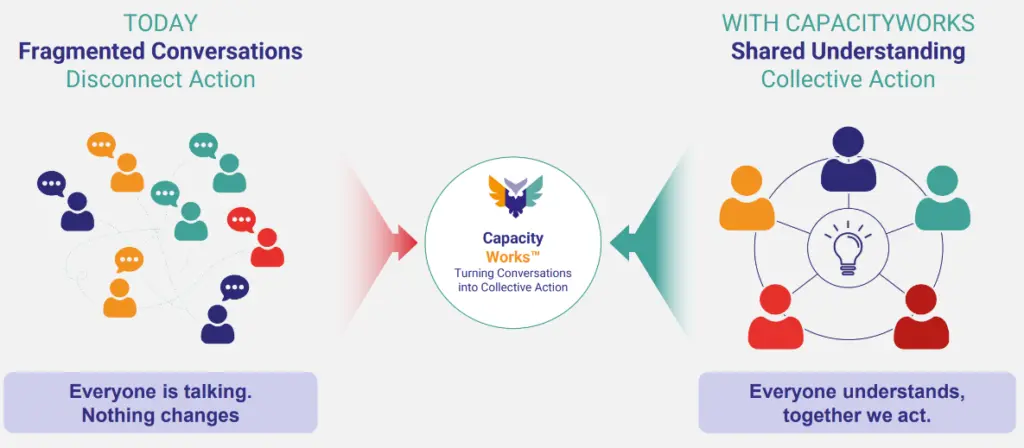
Everyone in your region is working on the same problem, just not together. Employers, educators, workforce boards, economic developers, and funders each decide what comes first on their own, and nobody finds out the plans don't match until the money's spent.
Labor force participation peaked at 67.3% in early 2000 and trended down to 62.6% in 2024 (Bureau of Labor Statistics). What's being taught is drifting further from what employers need. You've run the surveys, hosted the advisory meetings, gathered the labor data, and still get polite agreement that evaporates once the meeting ends. The real perspective stays hidden because nobody wants to be the one who says it out loud.
What's missing isn't effort. It's a way for everyone to see the same picture, and say what they really think, before the next grant, program, or hiring plan is locked in.
How CapacityWorks™ Helps Regions Decide Together
Two gaps keep the mismatch hidden. The Information Gap: no one holds the full picture.
The Candor Gap: no one says, out loud, what they really think. CapacityWorks™, our process adapted from Collaboration Arts' participatory framework, is built to close both.
Keep what you've built. Every region is different, so there's no template. We start with the programs, partnerships, and data you already have and close the gaps between them. First, a System Snapshot™ shows what each seat sees. Then the Regional Alignment Launch Series, three virtual working sessions, helps your region decide together.
Decide together. Own it together. In small-group, virtual sessions, everyone's input shows up on screen at the same time. The process guides understanding; it doesn't expose or blame. You bring what you know. Nobody's exposed alone, and everybody sees what they couldn't see on their own.
The facilitation methodology behind CapacityWorks™ has been used in hundreds of engagements in corporations and large NGOs. Applying it to regional workforce decisions is new. We’re asking funders to partner with us to build the first proof, with a method that has a record elsewhere. When an engagement ends, the region and its funders both hold the same proof of what the work produced: a picture of the system, priorities everyone agreed on, and commitments from each sector.
What You Stop Doing.
Deciding alone and in private because it's familiar and doesn't require trust. Meetings that end in polite agreement. Programs and openings built without seeing each other. If nothing old gets let go, it isn't collaboration; it's the appearance of collaboration.
Who We Serve
Built for change agents ready to act. Some of you feel the mismatch daily: the training director watching enrollment miss, the HR lead who can't fill roles. Others hold the budget and the standing to convene a workforce board, chamber, college, training provider, or employer coalition, not just attend one.
You’ve sat through the coalition meetings and the front-of-the-room facilitated convenings that produce polite agreement instead of real movement. That's the habit you're firing: meetings that end in polite agreement.
You’ve watched funding reach programs before your region ever agreed on what employers actually need, which learners are being prepared, or what should come first. Under Workforce Pell’s 70% standard, programs that miss the targets can lose federal eligibility, so standing still is getting expensive.1
1 U.S. Department of Education final rule, 91 Fed. Reg. 29254 (May 19, 2026); see also ACTE’s summary.
If you've seen that cycle enough times to know it won't fix itself, you're who we built this for. Make the call everyone stands behind: act with the full picture and your peers' backing.

Where and When We Work
Based in Louisiana. Built for any region. We're based in Mandeville, Louisiana, and the work happens in a virtual room, so no seat at the table is lost to distance, cost, or a packed calendar. The best time to start is before your next grant is awarded or program is approved.
Our 10-year goal: 700 collaborative engagements across 75 regions. Then we sunset, and the regions own the work.
The window doesn’t wait for a region to feel ready. Every planning cycle spent debating who should move first is a planning cycle that keeps the gap widening. Everybody protects their own turf, or waits for someone else to move first. Meanwhile, nobody finds out until the money's spent.
What we'll ask you
A free, no-obligation 45-minute conversation. We'll ask things like: When did "we need to work with the other stakeholders" first cross your mind, and what was happening right before that? What are you comparing this to: doing nothing, a consultant, a different convening? What would make you hold off? No commitment.